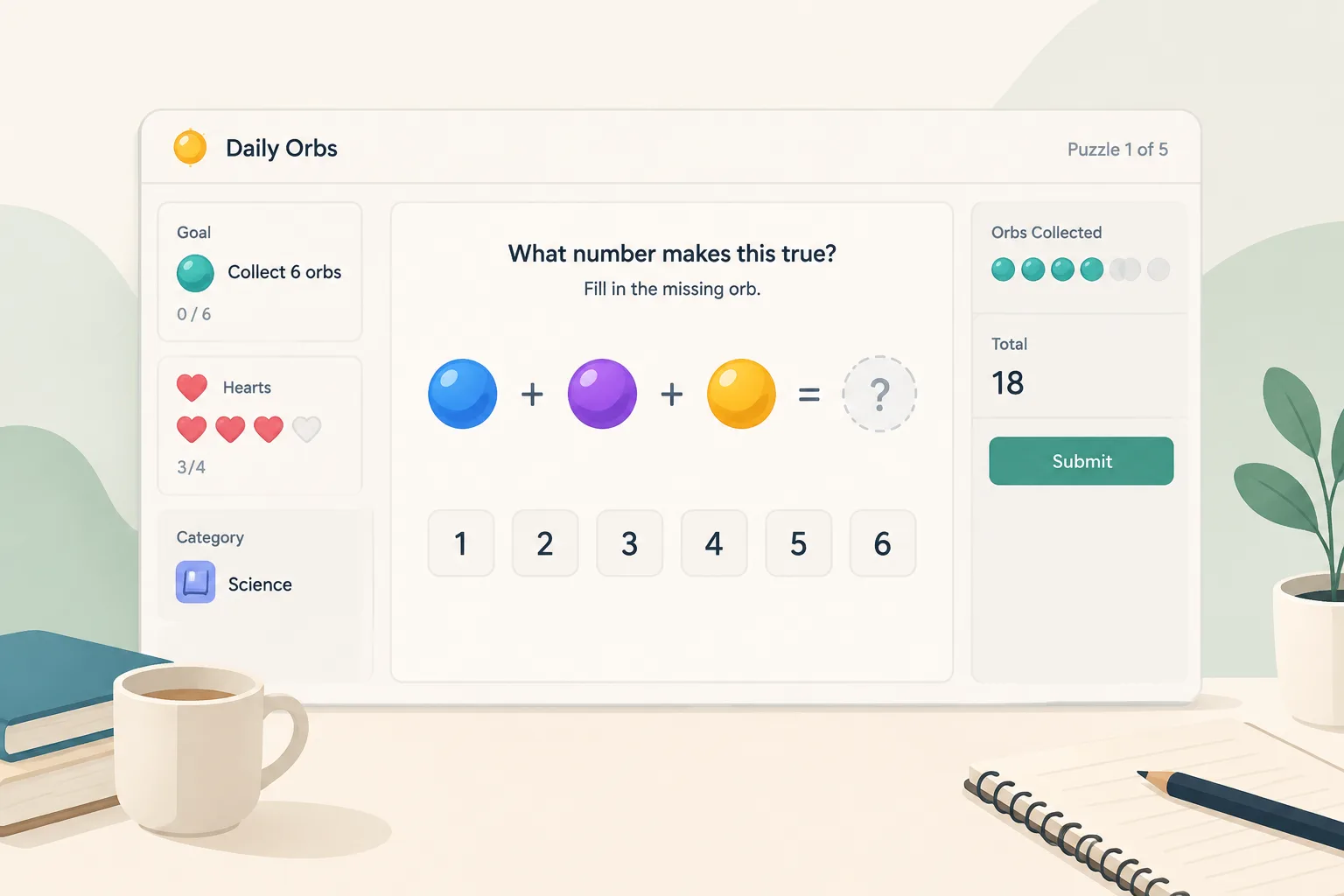
daily orbs 6 orbs
How to Win the Day in Daily Orbs: The Six-Orb Math
Master the six-orb math in Daily Orbs to win the day by understanding orb mechanics, hearts, and category strategies. Learn how to collect 6 orbs efficiently from the four daily puzzles.
How to Win the Day in Daily Orbs: The Six-Orb Math
How do you make Daily Orbs win the day happen for you? Collect 6 orbs across the four daily puzzles. This guide explains the six-orb math, how orbs are earned, the role of hearts, and practical strategies to succeed every day. Whether you are a new player or looking to improve your score, this article provides the insights needed to master the orb system.
Understanding the Daily Orb System
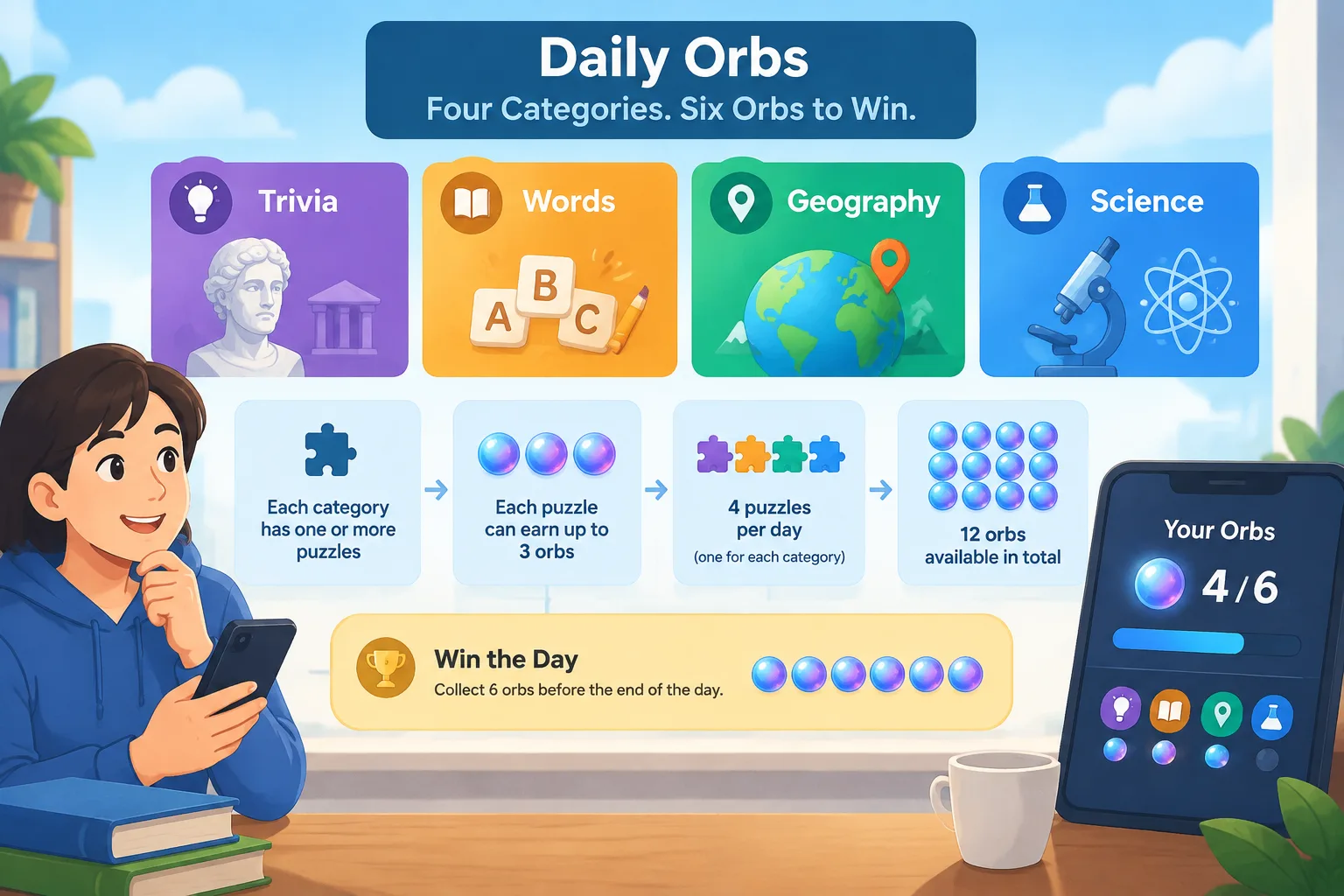
Daily Orbs is a daily puzzle game featuring four categories that rotate each day. These categories are trivia, words, geography, and science. Each category consists of one or more puzzles, with each puzzle allowing you to earn up to three orbs by answering correctly.
The official mechanics state that there are puzzles each day, three orbs per puzzle, and six orbs to win the day. Therefore, across the four puzzles, you have 12 orbs available in total. Winning the day requires you to collect 6 orbs before the end of the day.
The game encourages engagement with diverse topics, from historical facts to scientific principles. As you play, your orb count is displayed prominently, making it easy to track your progress toward the 6-orb goal.
For a complete introduction to the game, see our basics section.
The Core Six-Orb Math
The six-orb math is simple in concept but requires careful planning to execute successfully. Since you can earn up to 3 orbs per puzzle, the math is based on combinations of full and partial orb earnings.
To win, you must reach a total of 6 orbs. Possible combinations include:
- 3 orbs from two categories
- 3 orbs from one category, 2 from another, and 1 from a third
- 2 orbs from three different categories
These combinations allow you to win even if you don't fully complete every category. However, the hearts system introduces limitations that affect how many orbs you can realistically earn in each category.
It is derived from the official numbers that there are 12 orbs available, and you need half of them to win the day. This derived math helps players understand that skipping a category entirely is possible if you compensate with orbs from the other three.
How Hearts Limit Your Orb Potential
Hearts are a vital resource in Daily Orbs. Each puzzle starts with three hearts. An incorrect answer results in the loss of one heart. Once you have lost all three hearts, you are unable to earn any additional orbs from that specific puzzle.
This heart constraint means that the maximum orbs you can earn in a category is limited by how many hearts you have remaining. For example, if you get one answer wrong in a category, you might still be able to earn 2 orbs from the remaining correct answers. But if you get all answers wrong, your orb earnings for that category drop to zero for the day.
Understanding this interplay is essential for the six-orb math. You must decide when to take risks with hearts to maximize your overall score. In categories where you are confident, you can afford to answer more questions. In others, you may choose to answer fewer to preserve hearts.
For official details on hearts, refer to the how-to-play section.
Strategies for Maximizing Your Daily Score
To consistently win the day, implement these strategies:
- Prioritize categories you know well to secure full 3-orb rewards.
- Manage hearts by avoiding unnecessary risks in unfamiliar categories.
- Use partial orb earnings strategically to fill gaps.
- Monitor your total orb count throughout the day to ensure you hit 6 before time runs out.
By following these, you can turn the six-orb math into a reliable winning formula.
For advanced category-specific advice, check out our category guides.
Category by Category Orb Strategies
Each category has its own characteristics that influence how you approach earning orbs.
Trivia Category
Trivia questions cover a broad spectrum of topics including history, science, and pop culture. To earn 3 orbs, you need to answer correctly. These questions often have straightforward answers that can be recalled with basic knowledge.
Practical example: A question like "What is the largest ocean on Earth?" The answer is the Pacific Ocean. A correct response earns you the full 3 orbs.
To earn 2 orbs, you might answer a question where you are partially sure or use multiple choice options correctly.
Words Category
The words category tests your vocabulary and language skills. Questions may involve synonyms, antonyms, homophones, or word origins. Accurate answers are key to earning orbs.
Example: "Which of the following words means 'to make something new'?" The answer could be 'create' or 'invent'. Knowing the precise term earns 3 orbs.
Partial success might involve answering a related word question correctly to get 2 orbs.
Geography Category
Geography questions focus on locations, countries, capitals, and physical geography. These are often factual and benefit from general knowledge.
Example: "What is the capital city of Canada?" The correct answer is Ottawa. Getting it right gives you 3 orbs.
If you are unsure, you can use context from previous questions or general facts to earn 1 or 2 orbs.
Science Category
Science encompasses various fields like biology, physics, and chemistry. Questions can range from basic facts to more complex concepts.
Example: "Which of the planets in our solar system is the hottest?" The answer is Venus. Correct answer: 3 orbs.
To get 2 orbs, you might answer a question about the composition of the atmosphere or the number of moons.
Sample Scenarios to Practice the Math
Let's examine a few sample days to see how the six-orb math plays out in practice.
Scenario 1: You fully complete trivia and words (6 orbs), earn 1 orb in geography, and 0 in science. Total: 7 orbs. You win the day.
Scenario 2: You earn 3 orbs in trivia, 2 in words, 1 in geography, and 0 in science. Total: 6 orbs. Victory achieved.
Scenario 3: You earn 2 orbs in each of the four categories. Total: 8 orbs. You win comfortably.
These examples show how flexibility in the math allows for different approaches to winning.
Troubleshooting Low Orb Counts
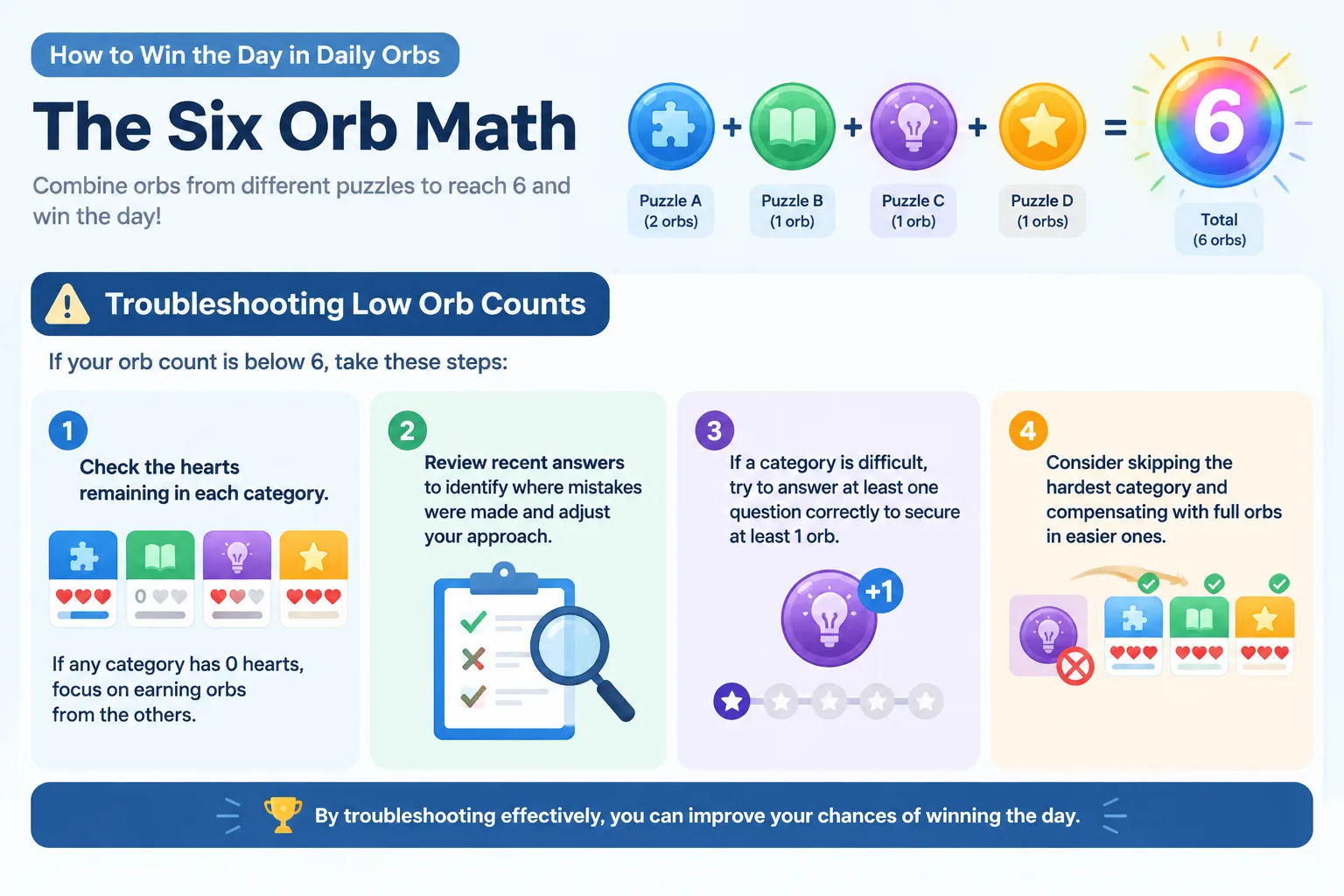
If your orb count is below 6, take these steps:
- Check the hearts remaining in each category. If any category has 0 hearts, focus on earning orbs from the others.
- Review recent answers to identify where mistakes were made and adjust your approach.
- If a category is difficult, try to answer at least one question correctly to secure at least 1 orb.
- Consider skipping the hardest category and compensating with full orbs in easier ones.
By troubleshooting effectively, you can improve your chances of winning the day.
Frequently Asked Questions
How many orbs do I need to win the day in Daily Orbs?
You need to collect 6 orbs to win the day.
What is the six-orb math?
The six-orb math refers to the strategy of earning 6 orbs out of the 12 available to win the day.
How do hearts affect orb earning?
Hearts limit orb earning by preventing additional orbs once all three are lost in a puzzle.
Can I win the day with less than 6 orbs?
No, 6 orbs is the minimum required to win the day.
What is the maximum orbs I can earn in a day?
The maximum is 12 orbs from four puzzles with three orbs each.
How do I know how many orbs I have?
The game interface shows your current orb count clearly.
Is it possible to fully max all categories?
Yes, by answering all questions correctly without losing hearts.
What happens if I make a mistake in one category?
You lose a heart, which may limit your orb earnings in that category for the day.
How can I improve my chances of winning?
By mastering the strategies, managing hearts well, and practicing the categories regularly.
Are the categories always the same?
The four categories rotate daily, but the orb mechanics and six-orb math remain consistent.
Conclusion
Mastering the six-orb math in Daily Orbs is all about smart orb collection and heart management. By following the strategies outlined here and practicing with the category playbooks, you can consistently win the day. Head over to the official game at dailyorbs.com to start playing and test these strategies yourself. For more wiki resources, visit our basics and category-guides sections.