
daily orbs science
Daily Orbs Science Guide: Approaching the Science Puzzle
A practical Daily Orbs science guide covering puzzle categories, reasoning methods, science tips, spoiler-light approaches, and ways to improve your answers.

Daily Orbs Science Guide: Approaching the Science Puzzle

The daily orbs science category challenges players to apply scientific knowledge, careful reading, and logical elimination. Daily Orbs is a daily four-category knowledge game, and the science section is designed around broad science understanding rather than memorizing one narrow subject. This guide explains how to approach science clues, how to build reliable solving habits, and how to use hints without immediately revealing an answer.
This wiki guide focuses on general preparation and reasoning techniques. It does not provide invented puzzle solutions or claim access to future Daily Orbs questions. For broader game information, see the Daily Orbs basics guide and the How to play Daily Orbs guide.
What is the Daily Orbs science category?
The Daily Orbs science category is a knowledge challenge where players solve science-related clues using concepts from areas such as biology, chemistry, physics, astronomy, Earth science, and measurement. The exact daily questions change, so successful players rely on understanding concepts and interpreting clues rather than memorizing a fixed answer list.
The science category is one part of the wider Daily Orbs structure. Players can also explore approaches for other categories through the Daily Orbs category guides. Science questions may reward familiarity with common scientific terms, but they also test whether a player can recognize relationships between ideas.
Common science question themes in general knowledge games include:
- Basic properties of matter and elements
- Living organisms and classification
- Space objects and astronomy concepts
- Physical forces and measurements
- Environmental and Earth science topics
A strong approach begins by identifying what type of science is being tested before trying to recall a specific fact.
How should you approach a Daily Orbs science puzzle?
A good Daily Orbs science puzzle strategy starts with identifying the subject area, separating certain knowledge from guesses, and using the available information carefully. Instead of searching memory for a complete answer immediately, break the clue into smaller scientific ideas and eliminate options that do not fit.
When facing a science clue, try this process:
- Read the wording slowly and identify keywords.
- Decide whether the clue relates to biology, chemistry, physics, astronomy, or another field.
- Recall related concepts rather than one isolated fact.
- Remove answers that conflict with basic scientific rules.
- Use a hint or reveal option only when further guessing could risk losing progress.
This method is useful because science knowledge is often connected. A question about an organism may involve classification, environment, and biological processes at the same time. A question about space may require understanding scale, motion, or observation methods.
What Daily Orbs science tips help improve accuracy?
The most useful daily orbs science tips focus on improving reasoning habits instead of memorizing random facts. Players can become more consistent by reviewing basic scientific concepts, learning common terminology, and practicing how to interpret clues before selecting an answer.
Useful habits include:
Build a science foundation
Review major concepts across different fields instead of concentrating only on one topic. A player who understands basic ideas about atoms, cells, planets, energy, and ecosystems will have more ways to connect clues.
Pay attention to scientific wording
Scientific terms often have precise meanings. Words describing size, location, function, or classification can change the correct interpretation of a clue.
For example, a clue about a process may ask about what something does, while a clue about a structure may ask what something is. Recognizing that difference prevents many avoidable mistakes.
Use elimination before guessing
Elimination is especially valuable when several answers appear possible. Scientific principles can often rule out incorrect choices even when the exact fact is not immediately remembered.
Review missed questions carefully
If a science answer surprises you, investigate the concept behind it. Learning the explanation creates stronger long-term knowledge than memorizing a single answer.
Which science topics should you study for Daily Orbs?
The best science preparation covers broad knowledge areas because Daily Orbs science questions can draw from many general science concepts. There is no verified public list of future science questions, so preparation should focus on transferable understanding.
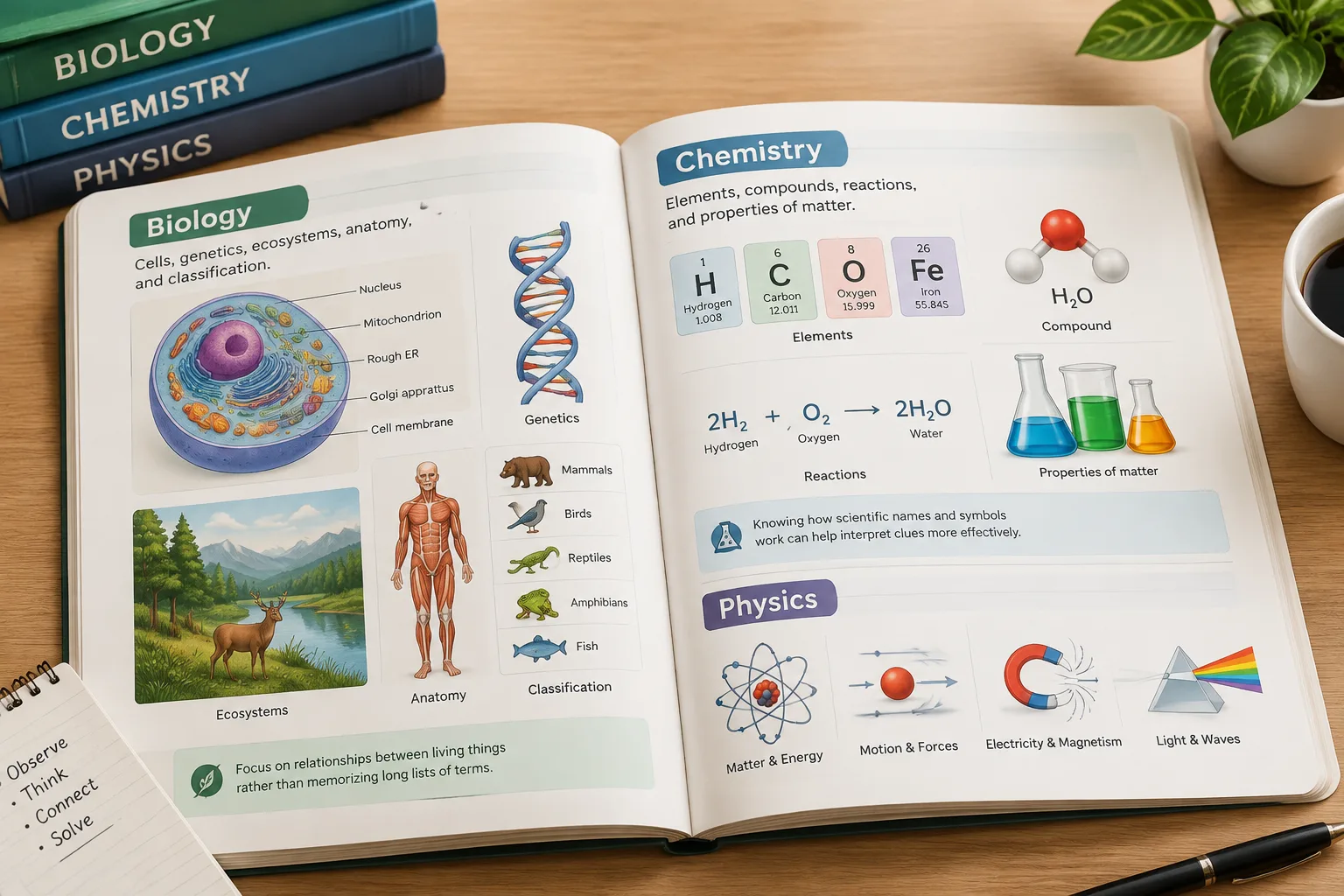
Important areas to review include:
Biology
Biology preparation can include cells, genetics, ecosystems, anatomy, and classification. Understanding relationships between living things is often more useful than memorizing long lists of terms.
Chemistry
Chemistry basics include elements, compounds, reactions, and properties of matter. Knowing how scientific names and symbols work can help interpret clues more effectively.
Physics
Physics concepts such as motion, energy, forces, light, and measurement appear frequently in general science education. A basic understanding of how these ideas connect can support puzzle solving.
Astronomy and Earth science
Topics involving planets, stars, weather, geology, and natural systems require understanding large-scale processes. Reliable references such as educational science resources from NASA can help build background knowledge.
How do Daily Orbs science answers differ from guesses?
Daily Orbs science answers are strongest when they come from a clear reasoning path rather than a quick guess. A correct answer supported by understanding is more valuable because similar concepts may appear in different forms later.
A useful answer-checking method is to ask three questions:
- Does the answer match the scientific definition?
- Does it fit every important word in the clue?
- Can you explain why the alternatives are less suitable?
If the answer passes these checks, confidence is usually higher. If uncertainty remains, consider whether using a hint is better than spending a limited attempt on an unsupported guess.
The official Daily Orbs experience can be found at dailyorbs.com. This wiki is an independent fan-made resource and is not affiliated with or endorsed by the developer.
How can you improve at the Daily Orbs science category over time?
Improving at the Daily Orbs science category requires regular exposure to concepts and reflection on reasoning mistakes. The goal is not only to know more facts but also to recognize patterns in how science information is organized.
A practical improvement routine can include:
- Reading short science explanations regularly
- Reviewing unfamiliar terms after playing
- Grouping knowledge by topic instead of memorizing isolated facts
- Practicing elimination with general science questions
- Keeping track of areas where mistakes happen most often
Players who enjoy tracking daily results can also explore the Daily Orbs answers section for available dated entries and explanations.
Frequently asked questions about Daily Orbs science
What is the Daily Orbs science category?
The Daily Orbs science category is the science-focused part of the Daily Orbs daily puzzle format. It tests general science knowledge and clue interpretation across areas such as biology, chemistry, physics, astronomy, and Earth science.
Where can I find Daily Orbs science answers?
Daily Orbs science answers may be available through dated answer resources when they have been verified. Players should check current entries carefully because daily puzzles change over time and this guide does not provide fabricated future solutions.
What are the best Daily Orbs science tips for beginners?
The best Daily Orbs science tips include learning core concepts, identifying the science field behind each clue, using elimination, and avoiding guesses based only on familiar words. A structured approach usually works better than random recall.
How do I solve a Daily Orbs science puzzle without a hint?
You can solve a Daily Orbs science puzzle without a hint by breaking the clue into key ideas, recalling related concepts, and removing answers that conflict with scientific principles. Careful reading is often as important as memorized knowledge.
Does the Daily Orbs science category require advanced science knowledge?
The Daily Orbs science category is designed as a general knowledge challenge, so advanced specialization is not always necessary. A broad understanding of common science concepts and good reasoning skills can help players approach many questions.
Are Daily Orbs science answers the same every day?
Daily Orbs science answers are not the same every day because the game uses daily puzzles. Players should verify answers against the specific date and puzzle rather than relying on a permanent answer list.
Continue exploring Daily Orbs guides
Science is only one part of the Daily Orbs experience. Continue learning with the basics guide, practice the complete game flow through How to play Daily Orbs, and explore more category strategies in the category guides.